Manage Your Pain with the Latest Treatments from Singing River Interventional Pain Management
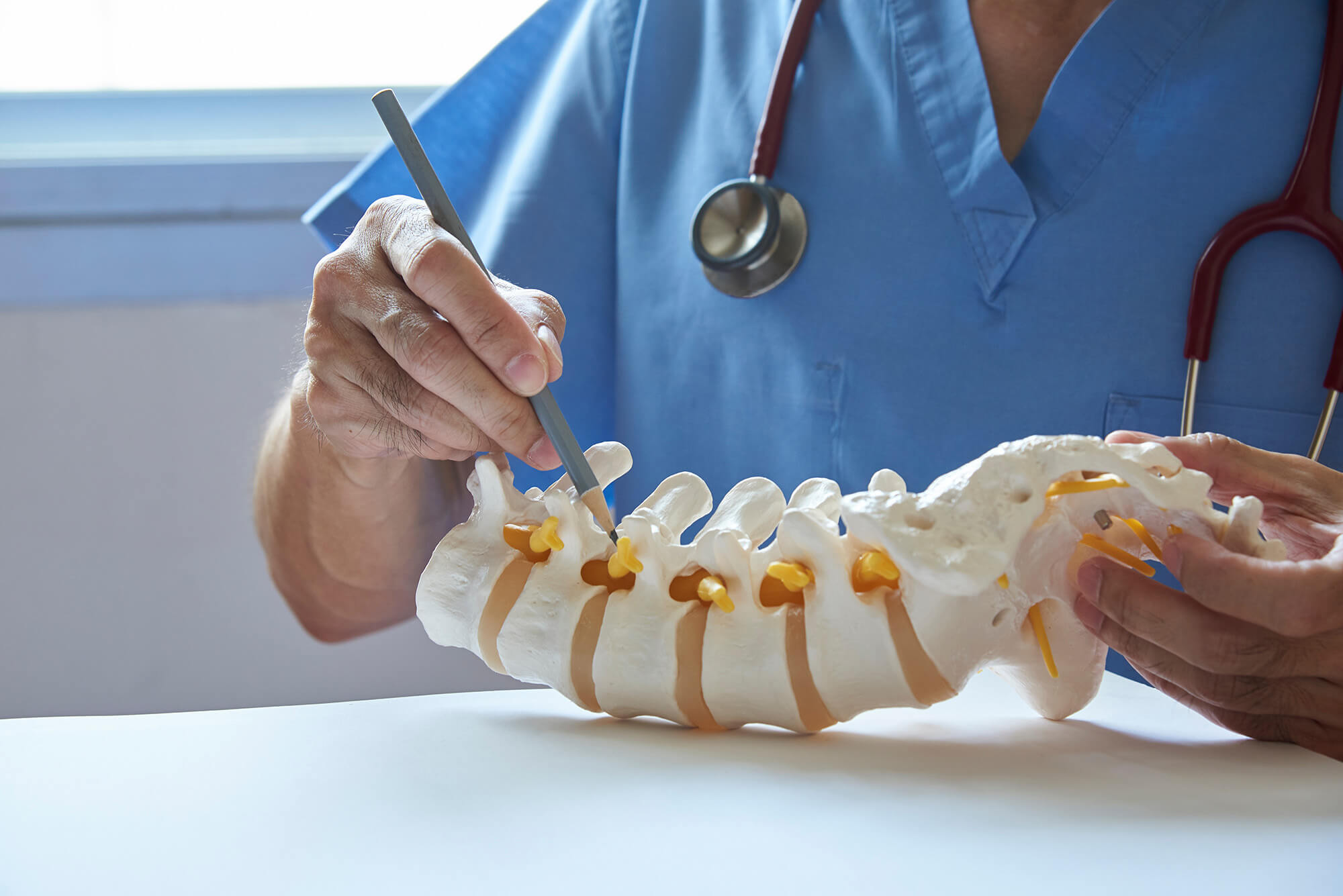
Singing River’s new Interventional Pain Management clinic, located in Gulfport, is helping patients dealing with acute and chronic pain using the latest technological advancements available. The clinic’s interventional pain management specialist, Joshua Dibble, DO, is a board-certified anesthesiologist who is passionate about helping patients on the Mississippi Gulf Coast manage their pain and return to regular activities.
Dr. Dibble recently spoke during Singing River Health Talk to Ricky Mathews about the field of pain management. They discussed treatments like epidural injections, nerve ablation, and spinal cord stimulation as well as options for issues like degenerative disc disease and lumbar spinal stenosis. Read an excerpt or watch the whole interview below.
“What is involved with Pain Management?”
Interventional Pain Management is on the cusp of a major transformation. 25 or 30 years ago, we didn’t have a lot of pain management tools at our disposal—it was largely medication and simple injections like epidurals that people may have heard about. We currently still do all those things, but we have so much more—new technology, new procedures, and new inventions that we can use to address pain in a variety of different ways.
That’s where my focus is. There’s a big problem with chronic opioid use in this country. The current trend in pain management is away from long-term opioid use and more towards multi-modal analgesia combined with interventional therapies. That’s what I’m passionate about.
“What is your first meeting with a new patient like?”
When you come to see me for the first time, it’s going to involve a detailed history. For the first five minutes or so, I’m going to sit there and let you talk. I’m just going to listen. I want you to tell me about when the pain started, where the pain is located, and all the things you’ve done to treat this pain prior to seeing me. I will interject a little bit and ask you a few questions.
Once we get a good history out of the way, I’ll do a physical exam. I have reviewed your chart and imaging before I’ve actually seen you, and I’ll go over your imaging with you. I’ll look at some of your pertinent lab values with you, I’ll tell you what I think is wrong, and then I’ll tell you what options we have to treat it.
That’s what you can expect when you come to see me for the first time. I like to listen to my patients, and it’s usually about 30 minutes. Oftentimes us doctors get very busy, but especially on the first visit when we’re just meeting each other, I like to give patients a full 30 minutes. I give them my time, I give them my attention, and we really try to establish a relationship.
“When you’re dealing with patients, they are probably a lot more aware of opioids, whereas before, a patient may have said, “Just give me what I need to take care of my pain.” It’s not that simple anymore, is it?”
No, it’s not. I’m benefitting from frank discussions I’ve had with many patients who have been on opioids for a long period of time, and there are two real things with opioids that you can’t get around: tolerance and dependence.
That makes it very challenging to give opioids on a long-term basis, although it used to be done. We know so much about that now, and in my opinion it’s not the best option for long-term pain control. That doesn’t mean people don’t have pain that lasts longer than two or three months—it just means that maybe opioids aren’t the best choice for those patients.
“How often have you dealt with someone like me that has to have surgery and cannot take traditional pain medications?”
Hypersensitivity to opioids is not common, but it is not uncommon to have people that, for various reasons, either can’t take opioids or it is not the best choice for them. Believe it or not, that’s more common than you think. It’s very common for people who can’t take opioids but are going to have a procedure.
So, how do you deal with that postoperative pain? The short answer is that you use a multi-modal approach—there is no one replacement of opioids. You have to do multiple different things.
“I was looking at the list of services and procedures. You have a lot of tools at your disposal, don’t you?”
Absolutely. I’ve been mentioning epidurals. This is where we put medicine in the epidural space. It’s the same space where women who have a baby get an epidural to help with labor pains. That can often help with pain that travels down the legs—what we call radicular pain. Epidurals have been around for a very long time. It’s a very safe procedure, and it works for a lot of people.
Epidurals are where treatments largely ended 30 years ago, and now it’s where treatments start. We have a very complex understanding of the nervous system of the body now, and so what we can often do is, depending on where areas of pain are, we can target nerves that supply fuel into that area, and we can go in and selectively block those areas. That’s a big part of what we do.
“When you do a nerve ablation, is it more permanent or longer term?”
It’s not permanent, but it is longer term. We like to see at least six months of relief from an ablation. Oftentimes we get longer than that—up to a year. When we do ablations, we’re targeting sensory nerves that supply or provide the brain with sensations of feeling.
When we go ablate those nerves, what we really do is send a small electrical current down at the tip of a needle, and that disrupts the function of that nerve. Eventually those nerves grow back, and the pain will return, but it is usually about a six-month duration of relief for many patients.
“Tell me about spinal cord stimulation.”
Spinal cord stimulation is under the category of neurostimulation. We place little nerve stimulation leads in that epidural space, and this will send a small electrical current to the spinal cord.
It distracts the pain signals from going to the brain. This is often used to treat patients with lower extremity symptoms or upper extremity symptoms—pain that travels down the legs like sciatica.
Neurostimulation or spinal cord stimulation is not the first line treatment, but if patients don’t respond to epidurals or other basic injections, that’s when we start thinking about spinal cord stimulation. It’s a two-step process. We let people try it for a week, meaning we put these leads in place, you go home, you try it out for a week. After a week, you come back, I take them out, and we have a discussion.
If you really enjoyed the pain relief, and you feel like it worked well for you, we schedule you for a permanent implant. That’s a game changer for many people. It’s not something we jump to right off the bat. We try other things, but for many people who’ve been dealing with pain for a long period of time, that absolutely changes their life.
“As we get older, do we also incur some degenerative disc disease?”
That’s exactly right. Degenerative disc disease is very common. Your discs kind of act like shock absorbers for the spine, and as we age, they often dry out.
The disc is composed of two parts: the outer part is the annulus fibrosus—basically thick cartilage, but the inner part is the nucleus pulposus—a kind of liquid gel material—that’s where the shock absorbing properties of the disc come from.
“What are some specific approaches to deal with degenerative disc disease?”
What can we do for people with degenerative disc disease? We can inject nucleus pulposus allograft from a donor right into that center part of the disc, and that helps restore some of the lost fluid of that disc. It helps some people restore a little bit of the function of that disc and help with vertebrogenic back pain.
This was not available even three years ago.
“Is that a procedure you’re doing?”
Yes. It’s an outpatient procedure and takes about 10 minutes to do. It’s done under x-ray guidance.
“Tell me about minimally invasive lumbar decompression.”
The acronym is mild®: minimally invasive lumbar decompression.
That is specifically for people with those radicular symptoms that we mentioned earlier, pain that travels down the leg or the sciatica pain. This procedure is for people who either don’t want open surgery, can’t tolerate general anesthesia, or are too old or too sick to tolerate open surgery.
This is minimally invasive; it’s done under light sedation. It’s an outpatient procedure, and this is an option for people who thought that surgery wasn’t an option for them.
mild® doesn’t stop you from having surgery should you need it. If for some reason, down the road, you need another surgery on your back, you’re not going to be precluded from having that.

About the mild® Procedure for Lumbar Spinal Stenosis
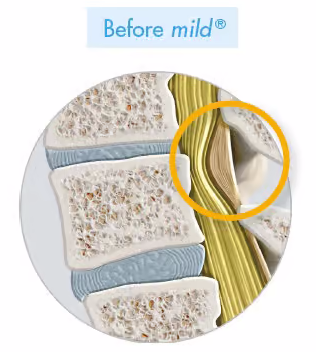

As we age, our lower spinal canal narrows, and this can cause pain, numbness, tingling or heaviness when standing or walking in the low back, legs, or buttocks. This condition is called lumbar spinal stenosis (LSS).
mild is a minimally invasive procedure done through a tiny incision under local anesthetic in which the doctor removes excess thickened tissue causing pressure on the spinal nerves. The procedure is done on an outpatient basis, and it does not require anesthesia, implants, stitches, steroids, or opioids. mild addresses the root cause of LSS and is covered by Medicare.
“People suffer from pain, don’t they?”
Absolutely, and by the time they get to my clinic, they’ve been dealing with it for a very long time. Oftentimes it becomes a situation where pain dominates all aspects of their life.
You’ll hear people say they avoid certain activities, or they don’t go out of the house, or they don’t attend certain functions because of their pain. That’s where it really tugs on my heartstrings, because life is about enjoying yourself and doing the activities that you love. My goal is to try to help people get back aspects of their life that they enjoy.
“When you help a patient, how does that make you feel?”
I get super excited. I have to kind of temper my excitement a little bit. I don’t want to oversell anything. I don’t want to promise patients something and under deliver, but I get excited. I mean, that’s why we do it, right?
All of us doctors went into this to help people. When I do a procedure or I initiate a therapy for somebody, and they come back and say, “you know, doc, since I’ve seen you last, I’m able to do X, Y, or Z”—man—that’s what I live for. That’s why I do this.
Treat Your Pain at Singing River Interventional Pain Management
Have your provider refer you to Dr. Joshua Dibble and make an appointment to see him at Singing River Interventional Pain Management in Gulfport.